Best of Paris in two hours – a walking tour through Paris
You have a layover. Or your Eurostar to London leaves at 5pm. Or you’re in Paris for one afternoon and spent the morning at the wrong museum. Whatever brought you here with only two hours, the question is the same: what’s actually worth seeing?
I’ve done this route more times than I can count — with first-time visitors, with people who’ve been before but never slowed down, and once alone between connecting trains. The version I’m sharing covers 4.2 kilometers, requires zero advance booking, and hits the moments that actually make people want to come back.
Two Hours in Paris Doesn’t Mean Rushing
Stop trying to see everything and pick one coherent corridor. The biggest mistake short-trip visitors make is plotting a route that jumps from the Eiffel Tower to the Louvre to Montmartre — that’s five hours of transit for thirty minutes of actual experience at each. Two focused hours beats six scattered ones every time.
The route below runs from Trocadéro to the Musée d’Orsay along the Seine. You cover it in about 50 minutes of movement, leaving 70 minutes for stops, photos, and a coffee. Flat, walkable, no tickets required to start.
The Full Route: Trocadéro to Musée d’Orsay
Start at the Trocadéro esplanade. Take Metro line 6 or line 9 to Trocadéro station — three stops from the Opéra area, €1.90 on a single t+ ticket from the RATP network. Walk up the steps to the Palais de Chaillot terrace, turn around, and you’ll see exactly what every Paris postcard is based on: the Eiffel Tower centered between the symmetrical wings of the palace, the Champ de Mars stretching behind it toward the horizon.
Spend 15 minutes here. Take your photos from the esplanade balustrade. Sit on the steps if there’s space. This is the view. Don’t rush past it to get to the tower itself — the tower from a distance is the experience.
Crossing the Seine: Pont d’Iéna
Walk down from Trocadéro to the Pont d’Iéna — about 5 minutes on foot. Cross the bridge and you’re at the base of the Eiffel Tower. Don’t queue for the elevators. In peak season (May through September), the wait runs 45–90 minutes even with a timed ticket booked online at toureiffel.paris (summit tickets cost €29.40 per adult). A 2-hour visitor has no business joining that queue today.
What you can do: walk around the base and look straight up through the iron lattice. That specific view — the underside of the tower from directly beneath — is something photographs rarely show, and it’s free. Take 10 minutes here, then move.
From the base, walk east through the Champ de Mars park. It’s a long, flat green corridor lined with Parisians eating lunch on the grass and tourists sprawled in the sun. Head toward Avenue de la Bourdonnais, about 8 minutes of easy walking.
Along the Seine: Quai Branly to Pont Alexandre III
Turn toward the river and head east along the embankment once you reach Quai Branly. This is one of the genuinely underrated stretches of Paris walking — the Seine on your left, Haussmann apartment buildings on your right, almost no tour buses. After about 15 minutes at a reasonable pace, you reach Pont Alexandre III.
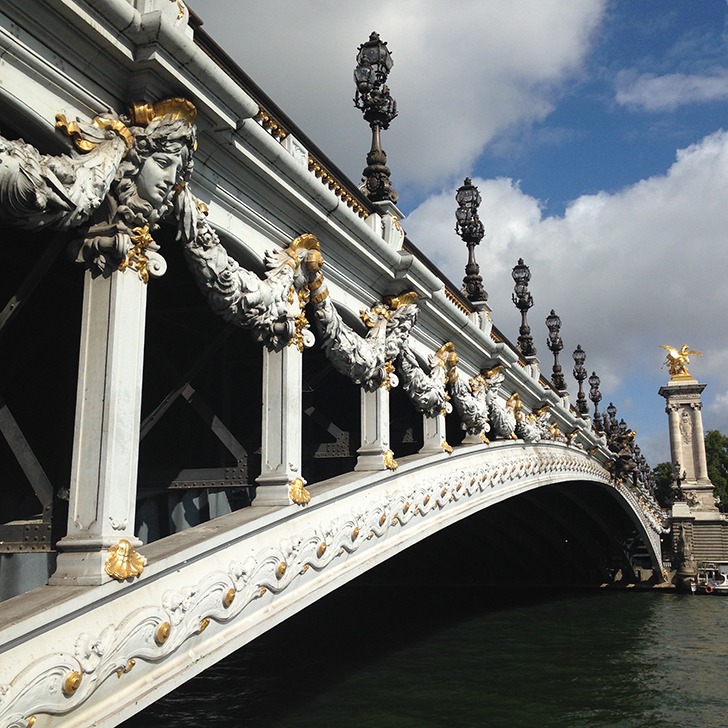
Stop here. This is the most architecturally extravagant bridge in Paris — built for the 1900 World Exposition, covered in gilded bronze sculptures, cherubs, nymphs, and four 17-meter columns capped with bronze Pegasi. From the center of the bridge you can see the dome of Les Invalides directly to the south and the Grand Palais and Petit Palais to the north. This is your second major photo moment, and it costs nothing to stand here as long as you want.
Final Stretch to Musée d’Orsay
Continue east along Quai d’Orsay. Pass the Assemblée Nationale on your right — the French parliament, a neoclassical façade worth a glance but not a stop. After roughly 15 more minutes of walking, you arrive at the Musée d’Orsay.
You don’t need to go inside to feel the weight of the building. The Orsay is a converted Beaux-Arts railway station — the glass roof, the ornate clock faces on the façade, the whole structure is striking from outside. But if you have time and energy left, entry is €16 for adults. The collection is the world’s greatest assembly of Impressionist painting: Monet, Renoir, Degas, Van Gogh, Cézanne. Book same-day timed entry at musee-orsay.fr — slots appear even in peak season, usually for afternoon windows.
Timing Breakdown: Where Your Two Hours Actually Go
Most people overestimate how long they’ll linger at each stop and underestimate how long it takes to walk between them. This table maps the route honestly:
| Location | Time at Stop | Walk to Next | Running Total |
|---|---|---|---|
| Trocadéro esplanade | 15 min | 5 min | 20 min |
| Eiffel Tower base | 10 min | 8 min | 38 min |
| Quai Branly riverbank walk | — | 15 min | 53 min |
| Pont Alexandre III | 10 min | 15 min | 78 min |
| Quai d’Orsay walk | — | 15 min | 93 min |
| Musée d’Orsay exterior | 10 min | — | 103 min |
The full route to the Orsay exterior runs about 100 minutes at a comfortable pace. That leaves roughly 20 minutes of buffer inside your two-hour window — enough for one unexpected photo stop or a coffee before you start. Fast walkers can do it in 75 minutes. People with young children or anyone who stops at every view should budget 2 hours 15 minutes and cut the Champ de Mars section short if needed.
Left Bank vs. Right Bank: Which Side to Walk
The route above stays primarily on the Left Bank (south side of the Seine). For your first time doing this walk, that’s the right call. Here’s why, and when the Right Bank alternative makes more sense:
| Factor | Left Bank (this route) | Right Bank Alternative |
|---|---|---|
| Crowd level | Moderate | Higher — tour buses park along Quai des Tuileries |
| Key sights | Pont Alexandre III, Invalides view, Orsay | Grand Palais, Tuileries Garden, Louvre Pyramid |
| Best for | Photography, first-timers, relaxed pace | Return visitors, museum-focused, shoppers |
| Food options en route | Sparse until Orsay area | More cafés along Rue de Rivoli throughout |
| End point | Orsay, easy cross to Right Bank via Pont Royal | Louvre Pyramid, then Palais Royal gardens |
If you take the Right Bank route, one detour is worth factoring in: Angelina on Rue de Rivoli (the original tearoom, not the airport branch). Their hot chocolate costs €9.50 and takes 15 minutes if you sit at the bar. It’s thick, almost solid, and one of those Paris food memories that sticks. Skip it if you’re pressed — but if you have the time, you’ll be glad you went.
Both routes are roughly the same distance. Pick based on where you’re headed next: Left Bank drops you near Saint-Germain and the 6th; Right Bank drops you near Les Halles and the Marais.
What to Skip Completely on a Two-Hour Paris Visit
These are the time sinks that eat your window without giving you anything worth trading it for:
- The Eiffel Tower elevators. Queue time: 45–90 minutes minimum, even with a timed ticket. The view from the summit is extraordinary — book it when you have half a day, not when you have two hours.
- The Louvre interior. Minimum viable visit: 3 hours. A two-hour visitor who enters will spend most of that time lost between the Denon and Richelieu wings looking for the Mona Lisa, which is smaller than expected and surrounded by a crowd holding phones in the air.
- Montmartre. A 30-minute Metro ride each way from the 7th arrondissement. With two hours total, the commute eats most of your window. Sacré-Cœur is worth seeing — save it for when you have a full afternoon.
- River cruises. The Bateaux Mouches and Vedettes du Pont Neuf tours run 70–90 minutes and cost €15–17 per adult. A river cruise takes the same time as this entire walking route and puts you on a boat instead of on the streets where Paris actually happens. Walking beats floating every time when time is short.
- Any museum requiring queue time at the door. Sainte-Chapelle, the Musée Rodin, and the Conciergerie are all excellent — on a different trip. Two hours is walking-tour territory, not exhibition territory.
Practical Questions Before You Go
What app should I use to navigate?
Citymapper is the best navigation option for Paris. It’s free, handles Metro-plus-walking combinations more accurately than Google Maps, and shows real-time RATP network disruptions. Download it before you leave your hotel — underground Metro stations often have no data signal. The official RATP app handles ticket purchase if you don’t have a physical Navigo card, but for navigation Citymapper wins clearly.
If you want audio context while walking, the Rick Steves Audio Europe app (free) has a self-guided Paris walk covering the Seine corridor. It’s not polished, but the historical context it provides at Pont Alexandre III and the Invalides area is genuinely good and worth playing at those two specific stops.
What should I wear on my feet?
4.2 kilometers on a mix of Paris cobblestones, gravel paths through the Champ de Mars, and paved quais. Wear real walking shoes with proper soles. Not sandals. Not fashion sneakers with thin flat rubber. The Trocadéro steps are polished stone that gets slippery when wet, and the Quai Branly embankment has uneven pavement throughout. I’ve watched people in heels give up and sit on the Pont d’Iéna wall after 20 minutes. That’s not a good use of two hours in Paris.
Is there anywhere to stop for food or coffee?
The route is light on café stops until you reach the Orsay area. Your best options by location:
- Before you start: Café du Trocadéro (Place du Trocadéro) — standard Paris brasserie, €3.50 for an espresso at the bar
- Mid-route near Les Invalides: Brasserie Thoumieux (79 Rue Saint-Dominique) — good terrace, €5–8 for a drink, 5-minute walk off the main route
- At the end: Boulangeries along Rue du Bac near the Orsay, or the café terrace inside the museum if you enter (€16 entry required)
For the best ice cream in Paris with a 20-minute detour: Berthillon on Île Saint-Louis (31 Rue Saint-Louis en l’Île) has been running since 1954. Two scoops cost about €4.50. Salted caramel and wild strawberry are the flavors most people regret skipping. Worth it only if your timing allows — it means crossing the river near Notre-Dame and adding roughly 20 minutes to your route.
Should I take a Vélib’ bike instead of walking?
Vélib’ Métropole, Paris’s city bike-share system, costs €3 for a 24-hour pass and is a solid option if you’re comfortable cycling on urban streets. The route above is almost entirely flat. On a bike, you cut transit time roughly in half — meaning you could extend the route all the way to Notre-Dame Cathedral or the Marais without blowing past two hours. Pick up a bike from any Vélib’ dock near Trocadéro and return it near Orsay. The app is free and docking stations are frequent enough on this corridor that you’re unlikely to get stranded.
The Best Way to Use the Last 30 Minutes
After reaching the Musée d’Orsay exterior, cross the river via Pont Royal — a 3-minute walk east from the museum entrance. You’re now on the Right Bank with roughly 30 minutes left if you’ve kept to the timing above.
Walk 8 minutes east along Rue de Rivoli and you reach the Louvre Pyramid. Don’t go inside — the Louvre requires 3+ hours to do properly. But the pyramid itself, I.M. Pei’s 1989 glass structure rising from the Cour Napoléon surrounded by the old palace wings, is one of those architectural moments that photographs don’t fully prepare you for. The contrast between centuries-old stone and modern glass — that’s very Paris. Stand in the courtyard for 10 minutes. That’s enough.
Then cut north through the Passage Richelieu archway into the Palais Royal gardens. Quieter than the Louvre plaza. Lined with uniform stone arcades housing small galleries and specialist shops. A central garden that feels like it belongs to a slower, older city. Hardly anyone on a rushed itinerary ends up here, which is exactly why it works as a final stop.
Start at Trocadéro for the view you came for, walk the Seine to Pont Alexandre III for the view you didn’t expect, and end at the Louvre courtyard or the Palais Royal for the version of Paris that belongs to you rather than to a checklist. That’s the walk worth doing in two hours.