An Afternoon at the Szechenyi Thermal Baths – the best Thermal Bath in Budapest?
You’ve been walking for three hours. Your feet hurt. The Danube views were beautiful, but you’re done with cobblestones. You pull up Google Maps and the first recommendation every travel forum gave you for Budapest is staring back: Szechenyi Thermal Baths.
I was skeptical the first time. The most famous tourist attraction in a city full of famous tourist attractions tends to disappoint. Szechenyi didn’t. But I’ve also sent people there who hated it — because they went on the wrong day, at the wrong time, with the wrong expectations.
Here’s the unfiltered version.
What Szechenyi Thermal Baths Actually Is
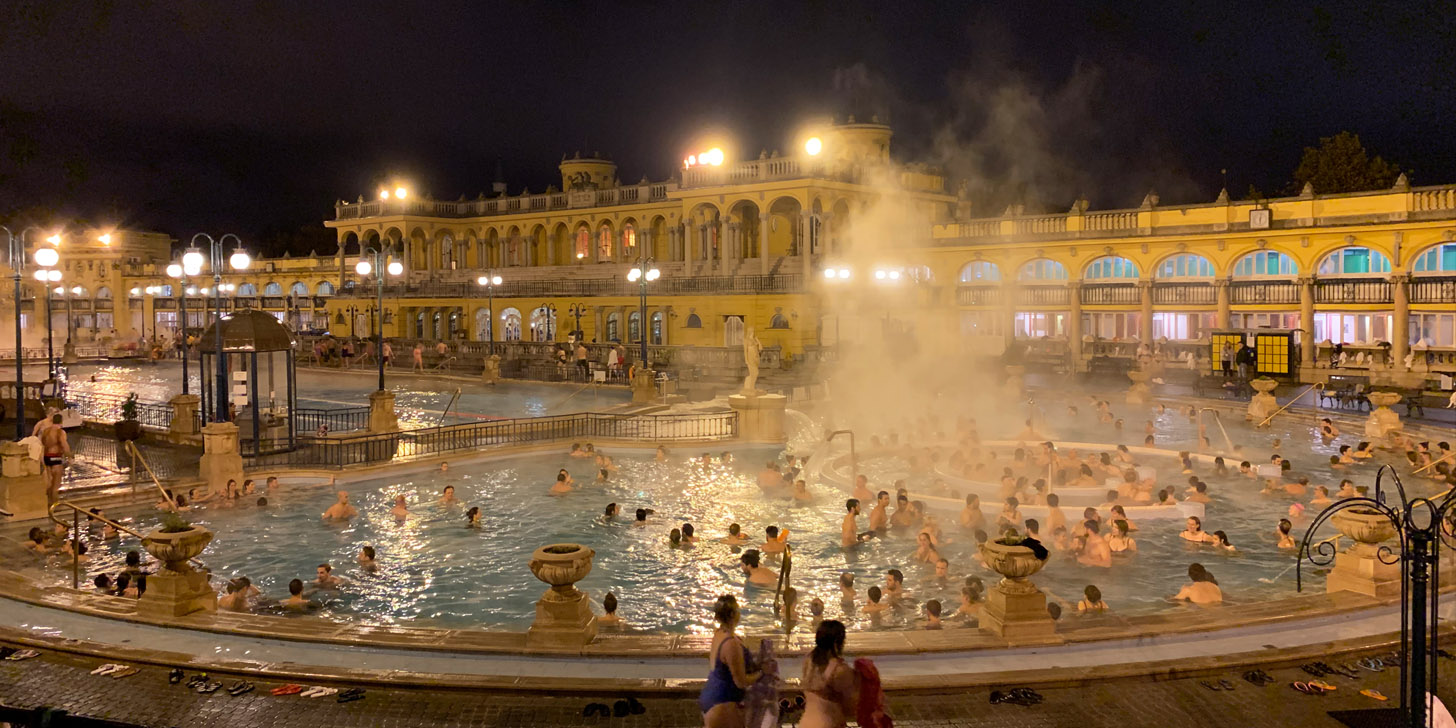
Szechenyi is the largest thermal bath complex in Europe, housed inside a yellow neo-baroque palace in Budapest’s City Park (Városliget). It opened in 1913. The building alone earns ten minutes of standing and staring — tiled ceilings, arched corridors, the particular faded grandeur of a place that has been doing exactly this for over a century.
There are 18 pools total. Three outdoor, 15 indoor. The outdoor section fills every Budapest travel photo: two large circular thermal soaking pools surrounded by that yellow facade, and one 50-meter lap pool. Water temperatures across the complex run from 18°C in the lap pool up to 40°C in the hottest indoor thermal pools.
The thermal water comes from two artesian wells drilled in the early 20th century, pulling geothermally heated water from roughly 1,000 meters underground. It reaches the surface at around 74–77°C and is cooled before reaching the pools. The water is high in calcium, magnesium, and sulfate — which is why your skin feels different after an hour in it. This isn’t heated tap water in a fancy building. The mineral content is real and measurable.
What the Thermal Water Actually Does
The claimed health benefits of thermal bathing sit somewhere between legitimate and wildly overstated, depending on who you ask. What is measurably true: prolonged soaking in water above 36°C reduces muscle tension, temporarily lowers blood pressure, and improves circulation. The mineral-rich water at Szechenyi has a higher dissolved solid content than standard thermal water, associated with anti-inflammatory effects at the skin level. Whether it fixes your bad knee is a question for a physiotherapist, not a travel writer.
What I can say: an afternoon here leaves you genuinely relaxed in a way a hotel pool does not. The heat is different. The water feels different. That’s not marketing — it’s just what thermal bathing does when you stay long enough to let it work.
Locker vs Cabin Ticket: Which to Buy
When booking, you choose between a locker ticket and a cabin ticket. A locker gives you a numbered space in a shared changing room. A cabin gives you a private cubicle — a small room with a lockable door where you can change without a crowd.
In 2026, weekday locker tickets run roughly €22–€25. Cabin tickets are €30–€35. Weekend prices are slightly higher across both types. If you’re visiting as a couple and care about changing privacy, the cabin is worth the premium. Solo travelers are completely fine with a locker. Either way, book online — the ticket desk queue on busy afternoons adds 20–30 minutes you don’t need to spend standing on pavement.
Is Szechenyi the Best Thermal Bath in Budapest?
For most visitors, yes. It’s the most complete, the most visually striking, and the best equipped to handle a full afternoon. But if you want something quieter, more local, or more historically atmospheric, a different bath serves you better. Szechenyi is the best default — not the best in every category.
Szechenyi vs Budapest’s Other Main Thermal Baths
Budapest has four major baths that come up consistently in trip planning. They are not interchangeable.
| Bath | Best For | Crowd Level | Price (2026 approx.) | Atmosphere |
|---|---|---|---|---|
| Szechenyi | Full afternoon, variety, scale | High (manageable on weekdays) | €22–€35 | Grand, social, tourist-heavy |
| Gellért Baths | Architecture, Art Nouveau interior | High | €20–€32 | Stunning but smaller pools |
| Rudas Baths | Ottoman history, dramatic atmosphere | Medium | €16–€25 | 16th-century dome, serious, dim |
| Lukács Baths | Local feel, budget, no crowds | Low | €14–€20 | No-frills neighborhood bath |
Gellért is the most architecturally beautiful interior of any bath in Budapest. The Art Nouveau tilework in the main hall is genuinely extraordinary. But the pools are smaller, the layout is more confusing, and it draws similar crowds to Szechenyi without the same capacity to absorb them.
Rudas is the outlier worth knowing about. The central Ottoman dome dates to the 16th century, with star-shaped skylights that cast patterns across the water. The main pool area holds maybe 40 people at capacity — intimate or claustrophobic, depending on your tolerance for close quarters. Rudas is for people who want to feel like they’ve found something, not just visited something.
Lukács is the local pick. Quieter, cheaper, less polished. Most people in the outdoor pool at Lukács live within walking distance and have been coming weekly for years. The water quality isn’t meaningfully different from Szechenyi’s — the dissolved mineral content is comparable. You’re paying the premium at Szechenyi for the scale and the building, not better water.
How to Plan a Good Afternoon Visit
Arrive between 1pm and 3pm on a weekday. Here’s a workable order of operations:
- Book online beforehand. Choose locker or cabin, save the QR code to your phone. The Állatkerti körút entrance has separate lanes for pre-booked visitors — this alone saves 20 minutes on busy days.
- Start in the outdoor pools. You’ll catch the best afternoon light on the yellow facade, and the outdoor pools are at their least crowded in early-to-mid afternoon. The middle outdoor pool (38°C) is where the chess players sit — older men playing on floating boards anchored in the thermal water. It’s real, not staged.
- Move inside before 4pm. The indoor thermal pools hit their quietest window between 2pm and 4pm. The main indoor hall has vaulted ceilings and glass roofing — it looks like the outdoor section’s older, more dignified sibling.
- Use the saunas. Finnish dry saunas and steam rooms are included in the standard ticket. Most visitors skip them. The sauna area is consistently quieter than the pools and extends the thermal effect meaningfully.
- Budget 2.5 to 3.5 hours total. Under two hours feels rushed. Over four hours and the heat accumulation leaves you genuinely drained when you exit.
- Eat before you go. The cafeteria inside is overpriced and mediocre. Andrássy Avenue has solid restaurant options 10 minutes away on foot. Sustained soaking in hot water burns more energy than it looks like — you will be hungry when you leave.
What to Expect Inside the Pools and Saunas
Are the outdoor pools worth the hype?
Mostly yes. The two thermal outdoor pools (38°C and 36°C) are large enough that even on moderately busy weekdays you can move freely. Water circulation is good — no stagnant corners. The 50-meter lap pool at 26°C works as a cooldown between thermal soaks but it’s a swimming pool, not a thermal experience. In autumn it’s nearly empty. In summer it gets actual lap swimmers treating it like their local pool, which is slightly surreal when you’re trying to decompress in the adjacent 38°C soak.
How crowded does it actually get?
Weekday afternoons: genuinely manageable. Roughly 100–200 people spread across the outdoor area at any given time. The pools hold far more, so it doesn’t feel packed. Summer weekends are a different calculation entirely. Entry queues stretch 40 minutes. The outdoor pools fill to the point where personal space disappears. If you’re visiting July or August on a weekend and insist on Szechenyi, book the 6am opening slot. Otherwise, book Rudas morning entry or Lukács — both handle weekend volume far better than Szechenyi does.
What should you actually bring?
Swimsuit (required), flip flops (the changing room floors are consistently wet — skipping these is a mistake you make once), a full-size towel (rentals are available for around €3–€5 but they’re thin and small), and a waterproof phone case if you want photos in the water. Lockers are standard gym size. Don’t bring a large backpack — there’s nowhere useful to put it.
The Mistakes That Will Ruin Your Visit
The single worst mistake: arriving on a Saturday afternoon in summer and expecting a spa experience.
You will queue. You will eventually get in. You will spend the first 20 minutes confused about the changing room system, which pool is which, and why your locker keeps releasing before you’ve secured it. The signage inside Szechenyi is genuinely poor for a facility that handles thousands of daily visitors. Nobody warns you about this.
Second mistake: moving too fast between pools. The point of thermal bathing is sustained soaking — at least 15 to 20 minutes per pool, alternating between hot thermal water and cooler water. People who cycle through every pool in 45 minutes leave having paid €25 for an expensive swim with a prettier ceiling. Stay in each pool long enough for the heat to actually do something. Slow down.
Third: skipping the indoor pools entirely. The Instagram version of Szechenyi is 100% outdoors. The indoor pools are older, more ornate, and consistently less crowded than the outdoor section. The main indoor thermal hall, with its vaulted ceilings and natural light through glass, is better-looking than the outdoor pools on most days. The people who skip it are the people who tell you Szechenyi was overrated.
Fourth: not accounting for the weekday-vs-weekend price gap before you arrive. Szechenyi charges meaningfully more on weekends, compounding the crowding issue. A Tuesday or Wednesday afternoon in September or October is the sweet spot — mild weather, manageable crowds, lower prices. That’s the visit worth booking.
Which Budapest Bath Should You Actually Book?
Szechenyi wins on scale and variety. It handles tourist volume better than any other bath in the city, and the outdoor section on a clear afternoon delivers something genuinely worth experiencing — not because travel writers say so, but because 18 pools in a 1913 neo-baroque complex with real thermal water is just hard to beat as an afternoon activity.
But it’s not the right choice for everyone or every situation.
- First-time Budapest visitor, want the full experience: Szechenyi — weekday afternoon, cabin ticket if budget allows, arrive by 2pm
- Architecture is your main interest: Gellért Baths — the Art Nouveau interior is unmatched anywhere in Budapest, even if the pool variety is limited
- Want something historic and atmospheric without tourist density: Rudas Baths — the 16th-century Ottoman dome with its star-shaped skylights is unlike anything else in the city
- Traveling solo on a tighter budget, want to sit with actual locals: Lukács Baths — cheapest entry, lowest crowds, no performance for tourists
- Summer weekend, no flexibility on timing: Skip Szechenyi. Book Rudas morning entry or Lukács instead. Szechenyi on a July Saturday afternoon is a queue and crowd management exercise, not a spa.
Three hours at Szechenyi on a weekday afternoon in September is one of the better things you can spend €25 on in Budapest. That’s the honest version.